What Is Brand Strategy? Here’s What It Actually Means for Your Business
Most small business owners think branding means a logo. They imagine a designer handing over a color palette and a sleek wordmark, and suddenly they have a brand. But here's what they don't realize: a logo without strategy is like a storefront without a business plan. It looks nice, but it doesn't really do anything.
Brand strategy is what tells that design or logo what to say. It's the blueprint that informs every design decision, every piece of copy, every client interaction. Without it, you're just decorating in the dark. A strong strategy is what separates creative branding from random design choices.
In this post, we're breaking down what brand strategy actually is, why it matters before you spend a single dollar on design, and how to start building yours.
What Brand Strategy Actually Is (And What It's Not)
Let's clear up what brand strategy is not. It's not your logo, color palette, or typeface. It's not a beautiful website or an Instagram grid. Those are all brand identity: the visual and verbal expression of your brand. Important? Yes. But they're the result, not the foundation.
Brand strategy is the decision-making framework behind all of that. It answers questions like: Who exactly am I talking to? What problem do I actually solve? How am I different from competitors? Why should someone hire me?
Think of it this way: strategy is the blueprint. Identity is the building. You need both, but you build the blueprint first.
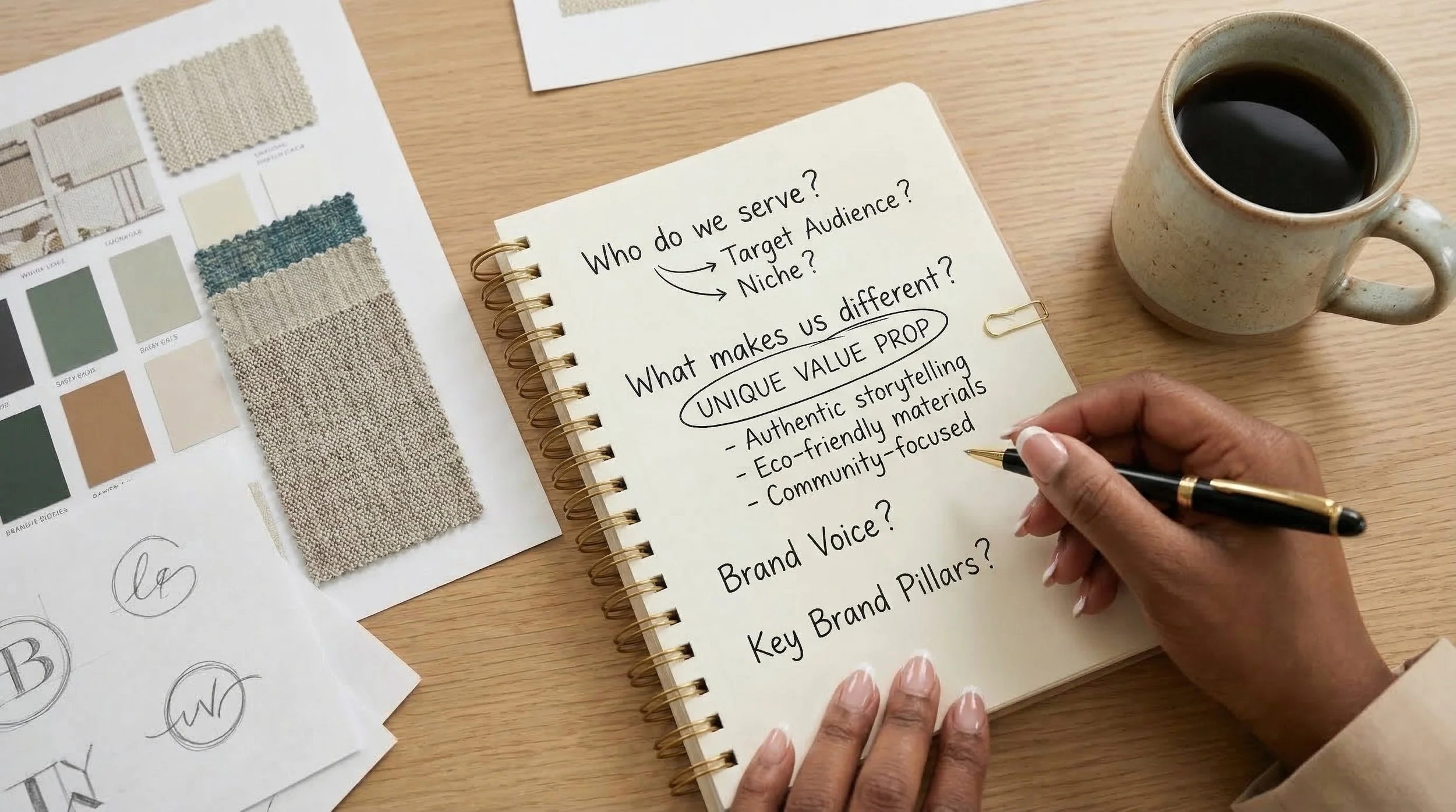
When we work on brand strategy at Constant Creates, we're not starting with mood boards. We're starting with clarity. Who do you serve? What do they actually need? What are you genuinely good at? What do you believe about your work? Strategy answers those questions in a way that shapes every decision that comes after. Strengthening your brand identity and establishing clear positioning creates the foundation for everything else.
Without strategy, a designer is just making aesthetic choices. With strategy, every design decision has a reason. Every color, every font, every piece of copy connects back to something real.
The 5 Core Components of a Working Brand Strategy
A solid brand strategy has five essential parts. You don't need to overthink these; they're just a framework to get clear.
Positioning is where you sit in the market relative to everyone else doing what you do. Not "best" or "most affordable." Real positioning is something like "the only estate planning lawyer in Manatee County who specializes in digital asset management" or "the bookkeeper who actually explains what's happening with your numbers." It's specific, defensible, and true about you. This clear distinction helps define your target audience more effectively and is the foundation of your authentic personal brand.
The target audience is who you're actually talking to. Not "small business owners," that's too broad. Try "service-based business owners with $500k-$2M in revenue who are profitable but lack a marketing strategy." That person has specific problems, anxieties, and budget constraints. Knowing exactly who you're serving makes everything else easier.
Brand personality is the human traits your brand has. Are you professional and formal, or warm and approachable? Bold and edgy, or calm and reassuring? It shapes how you talk, what you emphasize, and even how you design. A financial advisor and a fitness coach would have very different personalities. That difference shows up everywhere. Your personality should inform your brand voice across all communications.
Brand promise is what people can count on from you every single time. For a therapist, maybe it's "a safe space where you'll be heard without judgment." For a contractor, it might be "you'll understand what's happening with your project every step of the way." It's the consistent experience that builds trust and is a key part of your memorable brand identity elements.
Messaging framework is how you talk about what you do and why it matters. It's the language that ties everything together: your website copy, your social media, your email, your elevator pitch. When your messaging is aligned, people see your brand the same way across every platform. This is where mission statements become powerful tools for clarity.
These five components work together and are not independent. Your positioning informs who you target. Your target audience shapes your personality. Your promise and messaging flow from everything else. Get clear on all five, and your brand identity stops being a guess and becomes a real asset.

Why Brand Strategy Matters for Small Businesses
You might be thinking: "I'm a plumber. I'm a therapist. I'm a bookkeeper. Do I really need all this?" Yes, especially if you're a small business owner.
Without a strategy, every design and messaging decision is a guess. You end up with a website that looks cool but doesn't explain what makes you different. You have colors you picked because you liked them, not because they signal anything about your business. Your copy talks about features instead of benefits. You sound like everyone else.
Consistency builds trust faster than any ad campaign. When a potential client sees you on your website, then your Instagram, then gets an email from you, they should feel like they're experiencing the same brand. Not the same colors, the same feeling, the same voice, the same values. That consistency makes people think, "I can trust this person." It's what turns a stranger into a client. With the right brand strategy, this alignment happens naturally.
Here's something we've learned: people pay more for a brand they feel confident in. They don't pay more for better work; they pay more for a brand that feels established, clear, and trustworthy. This is where brand consistency becomes your competitive advantage.
Referrals increase when people can easily describe what you do and who you help. "You should work with Sarah, she's a therapist," doesn't generate many referrals. "You should work with Sarah, she specializes in helping high-achievers work through perfectionism and create better boundaries," gets way more. That specific positioning makes people think, "Oh, I know exactly who needs this."
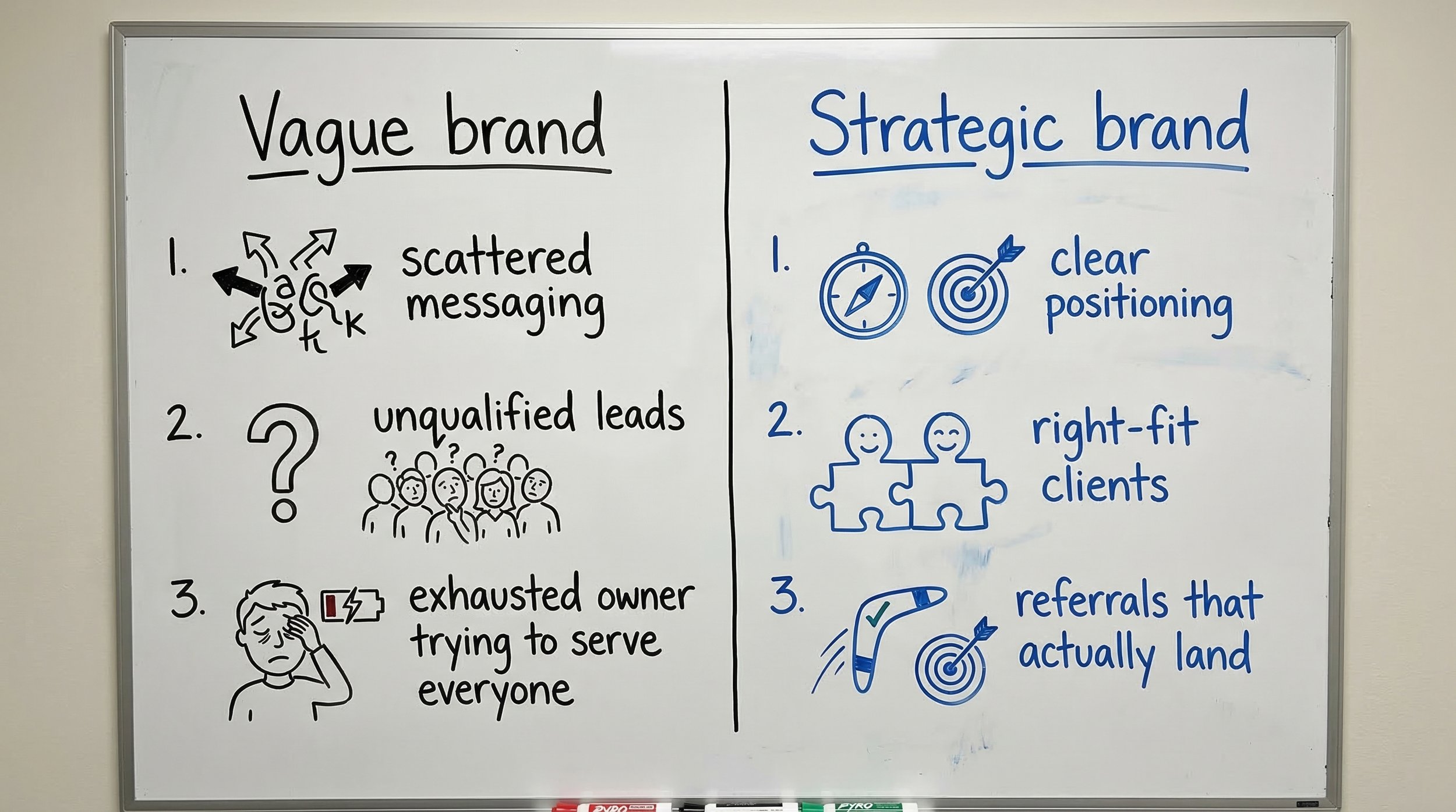
And here's something you don't always think about: you attract the right clients and repel the wrong ones. A vague brand attracts everyone, which means you end up working with people who aren't a good fit. A strategic brand is clear about who it's for, so the right people self-select in, and the wrong people naturally weed themselves out. That clarity alone is one of the most underrated benefits of having a real strategy. When you understand the psychology of branding, this client alignment happens naturally.
The Most Common Brand Strategy Mistakes
We see these patterns a lot.
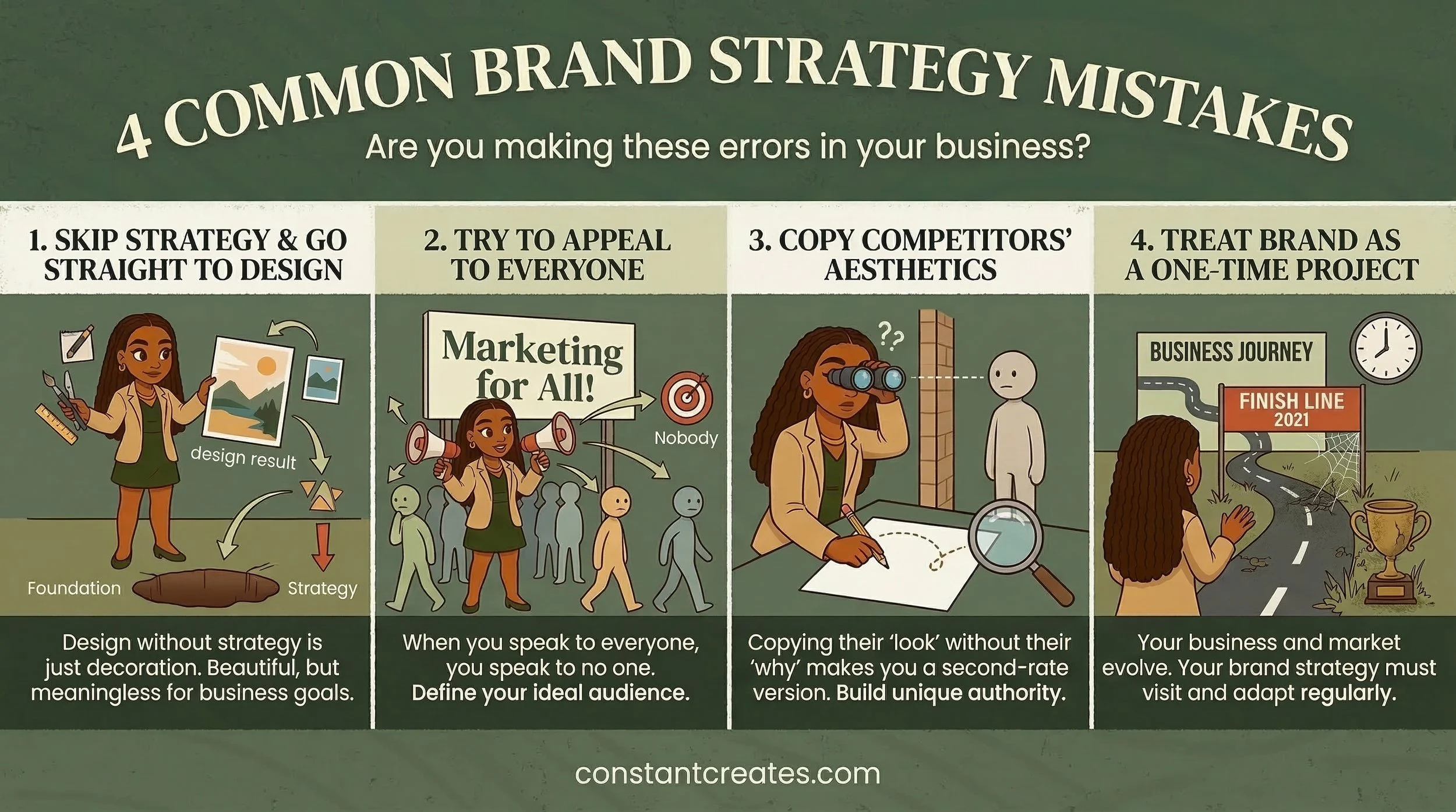
The biggest mistake is skipping strategy and going straight to design. Someone says, "I need a rebrand," so they hire a designer. The designer creates something beautiful, but it's beautiful in a vacuum. Six months later, the business owner is frustrated because the design doesn't feel like it represents their business. Of course it doesn't. No strategy was driving it. This is the gap between graphic design and brand design. That's why we always start with strategy before we ever touch the visual side.
Trying to appeal to everyone is another one. "I help anyone who needs marketing." "I work with all kinds of clients." That sounds inclusive, but it positions you for nobody. You can't build a brand that speaks to everyone. You need to pick your person, own that choice, and be excellent for them. This is why understanding your audience personas is critical. A clear target audience is the foundation of every decision that follows.
A lot of small businesses copy competitors' aesthetics without understanding the strategy behind them. You see a competitor's branding and think, "Oh, that looks professional," and try to match it. But you don't know why they made those choices. Maybe that aesthetic is perfect for their positioning, but it's wrong for yours. Instead, focus on building something truly unique, something that reflects who you actually are. Copying aesthetics without strategy just makes you look like a second-rate version of someone else.
Treating a brand as a one-time project is another trap. You work with an agency, get a beautiful new identity, launch it, and then you're done. But your business evolves. Your audience shifts. Your market changes. A strategy that worked great three years ago might not work now. You need to revisit it, test it, and refine it. Brand isn't a destination. It's a direction.
How to Start Building Yours
You don't need an agency, though we're always happy to help. You can start right now.
Get clear on three things: who you serve, what specific problem you solve, and how you're genuinely different. Not "better," different. What can you do that not everyone can? What do you do that others don't emphasize? Who specifically do you understand better than anyone else? Write those down. This foundational work is what separates a strong brand identity from something generic.
Let strategy inform every decision that follows. When deciding on your website colors, ask "Does this align with my positioning?" When writing copy, ask "Does this speak to my target audience?" When choosing which social media platform to invest in, ask "Where does my audience actually spend time?" Strategy becomes your decision filter. A brand audit can help you assess where you stand today, and brand maintenance keeps it aligned as you grow.
Revisit as your business evolves. You don't need to rebrand every year. But you should check in regularly. Are we still clear about who we serve? Is our positioning still true? Does our messaging still resonate?
When you build a real brand strategy, everything that follows becomes clearer. Your marketing becomes more targeted, your positioning stronger, your design choices more intentional. And your clients see you as the expert you actually are.
If you're ready to build a brand with real strategy behind it instead of guessing, we'd love to chat. Start the conversation here and let's see if we're a good fit.